
As demonstrated in
(Core Competency # 25), salespeople seem to have lost their ability to take and maintain control of the sales process. The Meeting Agreement is one of the best sales tactics ever to regain control and build an incredible amount of trust with the buyer. This simple, yet overlooked tactic will separate you from your competition and put new energy and success into your selling.
The Meeting Agreement (Remember “TAP Dance”)
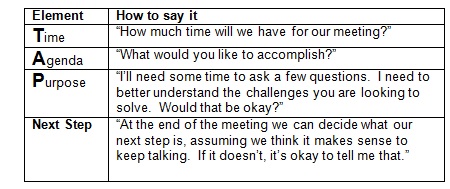
Obviously this is a very elementary example of a Meeting Agreement. The words can (and should) be changed to fit the situation and the individual’s style.
Where to use Meeting Agreements
- At the beginning and end of every meeting.
- After you’ve made a future appointment on the phone, set the Meeting Agreement. Reconfirm it when you arrive for the meeting.
Benefits of using Meeting Agreements
- We ensure that we have enough time to have an effective meeting.
- Both parties understand the purpose of the meeting.
- The salesperson has permission to ask questions, and the prospect understands that the salesperson is trying to understand his situation completely in order to be a problem solver, not a product pusher.
- The prospect knows he has permission to say “no” if there’s not a fit. This removes any hint of sales pressure.
- If the meeting is a success, a specific next step will be discussed. The often-heard response, “I need to think it over,” is eliminated.
Self-Study Assignment:
Develop your own Meeting Agreement for a first meeting with a prospect. Make sure you are comfortable with the words. Run it past your manager to make sure it fits the above criteria. Practice it until you are comfortable delivering it smoothly and professionally. Remember, the fewer words, the better.