
Years ago, the typical sale was transactional in nature. Small dollar deals were consummated in one meeting. Products were seen as commodities and were sold that way. The pressure on the seller was tremendous since he knew he usually had but one chance to close the deal. If he didn’t get the business, his competitor would. Faced with that challenge, sellers were trained to use manipulative techniques in an attempt to gain the upper hand.
Selling has, indeed, become more difficult.
Today the typical sale has become more relationship oriented and far more complex. The reasons for this are:
- The typical sale has become larger in dollar terms.
- Buyers have become more sophisticated and more knowledgeable.
- The impact of a poor buying decision becomes greater as the dollar amount of the sale increases.
- With greater risk, companies often involve more people in the decision process, which extends the sales cycle.
- The relationship between the vendor and the client often continues for some period of time, perhaps indefinitely, so
- People are looking for
problem solvers, not product pushers.
“Day by day, nothing seems to change, but pretty soon…everything’s different.”
Calvin, of Calvin & Hobbs
Salespeople have had difficulty noticing the change, and adjusting their selling approach.
You should
not
use the same strategies and tactics to sell an expensive, complex solution that you would use to sell a simple, low-tech product such as furniture, cell phones or even cars.
Here’s a comparison of the skills needed for the different types of sales.
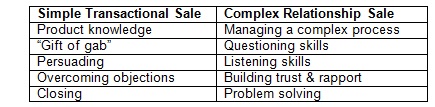
You may find that your selling environment has elements of both types of sales, and lots of gray areas in between.
For example, opening a new account with a company that will place orders on a regular basis may be more complex and relationship oriented. The regular orders you receive are more transactional in nature. Make sure you use the right selling tool for the job.
Self-Study Assignment:
What type of sale do you find yourself in? Think about what happens when you use the tools for a simple sale when you are in a relationship sale, and vice versa.